








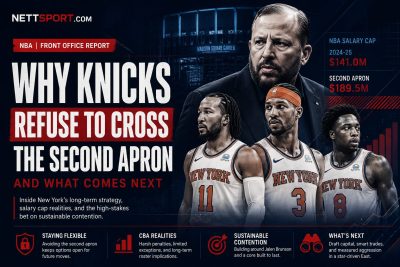
The New York Knicks are drawing a clear financial line, and it could shape the franchise for years.
Recent reporting and league-wide discussion have centered on New York’s apparent reluctance to move beyond the NBA’s second salary cap apron, a threshold that has become one of the league’s most restrictive financial barriers. The decision may frustrate fans who want aggressive spending, but inside front offices around the league, restraint is increasingly viewed as strategy rather than hesitation.
For the Knicks, avoiding the second apron is less about saving money and more about preserving options. The franchise has spent the last several seasons building credibility through measured roster construction. Crossing the second apron now could limit that flexibility at a moment when the Eastern Conference remains highly competitive.
Why the Knicks Refuse to Exceed the Second Apron
The second apron was introduced as part of the NBA’s updated collective bargaining framework and carries penalties that go far beyond luxury tax payments. Teams above the threshold face restrictions on trades, limits on aggregating salaries, reduced flexibility in acquiring players, and additional roster-building constraints. Those rules were designed to discourage high-spending teams from continuously stacking talent.
The details of the restrictions are outlined in the NBA’s salary structure guidance. Additional cap analysis has also been widely tracked by sports business reporting. For New York, the concern appears practical.
The Knicks already maintain a competitive core and have invested heavily in continuity. Crossing the second apron could complicate future moves and make midseason adjustments more difficult. Rather than maximizing one season, the front office appears focused on extending a multi-year window. That approach aligns with broader league trends. Several contenders have started managing payroll with long-term maneuverability in mind. While fans often associate spending with ambition, executives increasingly evaluate whether spending creates enough marginal improvement to justify losing flexibility.
Knicks Salary Strategy Could Affect Future Roster Decisions
The roster implications could become more visible over the next 12 to 18 months. Salary cap management now influences nearly every basketball decision. Extensions, trade targets, bench construction, and timing all become interconnected. If the Knicks remain below the second apron, they preserve more paths for future adjustments.
That flexibility matters. A front office with optionality can react to injuries, market opportunities, and unexpected player movement. A capped-out team has fewer answers when conditions change.
New York’s recent trajectory suggests leadership values controlled growth over dramatic swings. The organization has avoided short-term moves that could weaken future positioning. That pattern may continue if the financial environment becomes even more restrictive. Critics will argue the Knicks should capitalize immediately while momentum exists.
Supporters of the current approach see a different calculation: maintaining enough freedom to stay relevant over multiple seasons instead of forcing one expensive push. Neither approach guarantees success. But one creates more pathways.
What the Second Apron Means for the Knicks’ Long-Term Future
The larger question is whether restraint today improves championship odds tomorrow. That answer depends on timing. If a transformational player becomes available, preserving flexibility may allow New York to act quickly. If no major opportunity appears, avoiding the second apron still protects roster depth and operational freedom.
The modern NBA increasingly rewards organizations that balance talent acquisition with financial structure. The Knicks appear willing to operate within that reality. That does not mean spending will stop. It means spending may happen selectively. The franchise can still pursue upgrades, extend key contributors, and remain competitive without triggering the most restrictive financial consequences.
For now, the signal coming from New York appears straightforward. The Knicks are not avoiding investment. They are choosing to control when and how investment happens. That distinction could define the next stage of the franchise’s development.
Dolan Draws a Line: Knicks Owner Rules Out Second Apron Spend
How NBA Second Apron Rules Affect Knicks Future and Roster Flexibility