








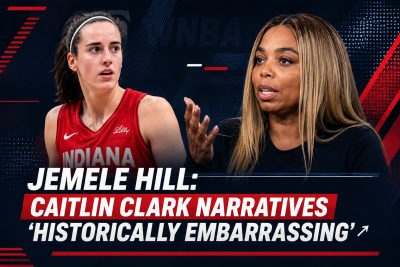
The WNBA finds itself at a pivotal moment, navigating unprecedented attention, much of it centered on Indiana Fever star Caitlin Clark. Amidst this surge, veteran sports commentator Jemele Hill has offered a pointed critique of the prevailing media narratives, asserting that the idea of WNBA players wanting to harm Clark ‘will prove to be historically embarrassing.’
Unpacking the ‘Historically Embarrassing’ Claim
Jemele Hill, a respected voice in sports journalism, recently delivered a sharp assessment of the media’s portrayal of WNBA dynamics. During an appearance on the Awful Announcing Podcast, Hill directly addressed the persistent storyline suggesting animosity towards Clark. She made her strong declaration after covering the WNBA All-Star weekend, gaining firsthand insight into the league’s atmosphere.
Hill firmly stated that the media’s narrative—that players dislike Clark, are jealous of her, or wish to hurt her—’is not the dominant perspective or feeling in the league.’ These pervasive Caitlin Clark narratives often misrepresent the reality of player relationships and the professional environment. Clark, a 24-year-old talent, has undeniably become a transformative figure, attracting a level of public interest the WNBA has never before witnessed.
However, her rise has also inadvertently positioned her as a central figure in America’s culture wars, a straight white point guard in a league predominantly featuring Black and LGBTQ athletes. Hill expressed deep empathy for Clark, noting that much of this intense, politicized scrutiny was not sought by the player herself. ‘She didn’t ask to be some kind of bat signal for a culture war,’ Hill articulated, emphasizing the external pressures burdening Clark. Hill further highlighted that Clark did not ask to become a ‘vessel to get off as much racism as they possibly can’ for a vocal, though minority, segment of fans. The commentator drew parallels between the intense focus on Clark and other sports-related issues, such as transgender athlete laws, which conservative media have similarly co-opted for their programming. ‘Anything that happens with Caitlin Clark, it gives Fox (News) programming for six hours,’ Hill observed, illustrating the politicized lens through which many view Clark’s career. Such sensationalized *Caitlin Clark narratives* frequently overshadow her athletic contributions and the genuine interactions among players.
The Reality of League Relationships and Caitlin Clark Narratives
Despite the often-dramatic media portrayals, Hill maintains that authentic connections thrive between Clark and her teammates. She pointed to the ‘real relationship’ shared by Clark and veteran teammate Kelsey Mitchell, a fellow All-Star, as compelling evidence. This perspective directly contradicts the widespread media assertion that WNBA players harbor resentment or ill will towards the league’s newest star. The league’s future trajectory is being shaped by how it manages this unprecedented attention, with the integrity of player relationships forming a crucial foundation. The ongoing discourse surrounding Caitlin Clark narratives frequently misses the nuanced reality of a professional sports league.
Hill believes that even less politicized media will, in hindsight, face criticism for prematurely concluding that other players ‘don’t like’ Clark or ‘want to hurt her.’ The WNBA stands at an inflection point, where its success depends on navigating the ‘inordinate attention’ around Clark without uninformed media perspectives and false narratives capturing its story. The constant scrutiny and the immense pressure to perform under such a spotlight would challenge any young athlete. Clark’s role as a significant revenue generator for the league is undeniable, driving viewership and financial growth like never before. However, this commercial success should not be conflated with a lack of camaraderie or respect among her peers. The media holds immense power in shaping public perception, and Hill’s comments serve as a vital reminder of this responsibility. The WNBA’s efforts to manage its public image and enforce league rules constantly face scrutiny; even its social media posts draw careful monitoring and, at times, removal, a situation the Los Angeles Times highlighted.
Beyond the Hype: A Call for Informed Perspective on Caitlin Clark Narratives
Jemele Hill’s insights provide a crucial counter-narrative to the often-sensationalized coverage of Caitlin Clark’s arrival in the WNBA. Her call for a more informed and empathetic perspective gains particular relevance as the league continues its rapid growth in popularity. The long-term success of the WNBA, Hill implies, depends on its ability to move past these divisive Caitlin Clark narratives and present a more accurate portrayal of its athletes and their interactions. The current media landscape, with its tendency for quick judgments and amplification of conflict, presents a significant challenge. It is imperative that the focus remains on the sport itself and the incredible talent within the league, rather than manufactured drama.
As the WNBA progresses, the challenge will be to ensure that the genuine stories of its players and the league’s evolution are accurately conveyed, free from the distorting lens of culture wars and unfounded animosity. Hill’s prediction of historical embarrassment for those perpetuating negative Caitlin Clark narratives stands as a powerful warning and a call for journalistic integrity.