








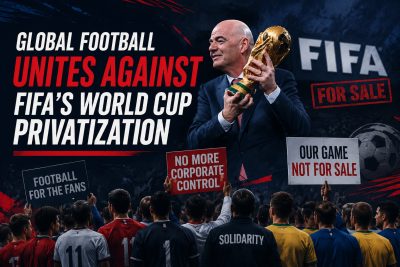
Zurich, Switzerland – The global football landscape is currently being rocked by an unprecedented wave of opposition directed squarely at FIFA’s leadership. Despite a growing chorus of dissent from major confederations, football’s governing body is pressing ahead with its controversial plans to privatize commercial aspects of the World Cup. The latest development saw the Asian Football Confederation (AFC) officially join UEFA and Concacaf in rejecting the proposal, creating a formidable united front that now encompasses a significant majority of FIFA’s member associations and places President Gianni Infantino’s tenure under intense scrutiny.
FIFA’s proposal involves the creation of a new commercial company, FIFA Forward Enterprise (FFE), which would see shares in the World Cup sold to private investors. This move has been met with widespread alarm, with critics arguing it could fundamentally alter the spirit and governance of the sport. The backlash, initially spearheaded by European and North American bodies, has now gained critical mass with the AFC’s intervention, signaling a deep-seated distrust in FIFA’s current decision-making processes.
A United Front Against FIFA’s Commercial Vision
The AFC’s strongly worded statement, issued on Friday morning, echoed the sentiments of its European and North American counterparts, urging FIFA to undertake an urgent review of its governance and decision-making framework. The confederation explicitly stated that the FFE proposal “cannot realistically achieve the necessary broad consensus and unity required to move forward.” This stance goes further than Concacaf’s public rejection, which, while firm, did not explicitly call for the plan to be dropped, though it stopped short of matching UEFA’s threat of a full boycott.
UEFA, representing all 55 European nations, had previously confirmed plans to boycott all FIFA competitions in the future if the World Cup sell-off proceeds. This unprecedented threat underscores the gravity of the situation and the depth of opposition within the sport’s most powerful confederation. The combined strength of these three confederations – UEFA, Concacaf (North, Central American, and Caribbean soccer), and the AFC – is immense. Together, they represent 143 of FIFA’s 211 member associations. For Infantino’s plans to be put into action, the support of 106 member associations would be needed, making the current coalition a virtually insurmountable obstacle if it remains united.
The immediate effects of a potential boycott could be felt in the women’s game, with the Women’s World Cup next summer in Brazil being the next senior FIFA competition. The prospect of major European, Asian, and North American teams withdrawing from such a flagship event would undoubtedly cast a long shadow over the tournament and FIFA’s reputation.
FIFA World Cup Privatization Plans: Infantino Doubles Down
Despite this unified front, FIFA President Gianni Infantino appears resolute, with the organization releasing an early morning statement doubling down on its commitment to the proposal, as reported by Sports Illustrated. The statement, issued at 4 am UK time (late Thursday night in the US), blamed the widespread blowback on “incorrect” or “erroneous media reports” that allegedly disrupted its “planned consultation process” for member associations. FIFA insisted it would “proceed with this consultation process to ensure that each MA [member association] has the ability to express its vote based on facts.”
FIFA’s defense of the FFE proposal centers on the claim that it is designed to empower member associations. According to the organization, FFE has been proposed “solely to ensure that all FIFA Member Associations have the opportunity to take meaningful ownership of the commercial opportunity of football in their respective countries.” Furthermore, FIFA maintains that it would retain ownership and control of FFE, emphatically stating, “Nobody is selling football. This is not something FIFA would ever entertain.” The proposal also includes a significant incentive: a promise of $20 million in development funding over four years for each member association should the plan be approved.
Governance Under Scrutiny and the Road Ahead
Gianni Infantino’s position as FIFA president, a role he has held since his election in 2016, is now under significant threat for the first time. Unless he backs down quickly from the controversial World Cup privatization plans, his leadership is being challenged on an unprecedented scale. The calls for an urgent review of FIFA’s governance and decision-making framework are growing louder, reflecting a widespread concern over the transparency and consensus-building within the organization.
The current standoff highlights a deep divide between FIFA’s executive leadership and a substantial majority of its global membership. The consultation process, which FIFA insists on continuing, is now taking place amidst a backdrop of widespread distrust and demands for fundamental changes to how decisions are made at the highest level of international football. The unity demonstrated by the major confederations presents a formidable challenge to Infantino’s agenda and could ultimately reshape the future commercial landscape of international football, forcing a re-evaluation of how the sport’s most valuable assets are managed and distributed.