








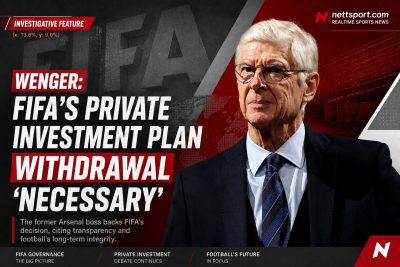
Arsene Wenger, FIFA’s esteemed Director of Global Football Development, has emphatically declared the recent withdrawal of the organization’s private investment plan as “absolutely necessary and beyond question.” His strong statement adds a significant voice to the chorus of opposition that ultimately forced FIFA President Gianni Infantino to abandon the controversial proposal, which aimed to sell a 20% stake in the World Cup to external investors. This development underscores the ongoing tension between commercial interests and the foundational principles of global football governance.
Wenger Challenges FIFA’s Private Investment Plan
Wenger, who joined FIFA in 2019, clarified his position in a statement, emphasizing his commitment to the integrity and independence of global football. He revealed that he was not involved in the strategic plan and only became aware of the project through media reports. This lack of internal transparency surrounding the initiative raised significant concerns. “The recent events at FIFA deserve some clarity from my side,” Wenger stated, asserting his firm belief in an independent FIFA that serves the game with commitment, transparency, and integrity. His extensive role within the organization encompasses vital areas such as data analysis, the FIFA online training center, and the development of youth education through 60 academies established in countries most in need. Additionally, he serves as a technical advisor to the International Football Association Board (IFAB), the body responsible for the Laws of the Game. This broad involvement in football’s technical and developmental aspects lends considerable weight to his critique of the proposed financial restructuring.
The Controversial Proposal and Its Rejection
President Gianni Infantino spearheaded the now-aborted FIFA private investment plan. It sought to establish a new commercial subsidiary, FIFA Forward Enterprise (FFE), through which a 20% share of the World Cup could be sold to private entities. This ambitious proposal, unveiled just a week before its ultimate retraction, quickly ignited a firestorm of criticism across the football world. Infantino had reportedly offered each of FIFA’s 211 member associations a substantial sum of $40 million if they supported the plan, a move many saw as an attempt to secure votes. However, the backlash proved swift and severe. Three major confederations explicitly rejected the project. The Union of European Football Associations (UEFA), representing 55 European federations, went as far as threatening to boycott all FIFA tournaments, including the prestigious World Cup, if the plan were to proceed. This collective pressure proved insurmountable, compelling Infantino to reverse course. Strong opposition was rooted in concerns about the potential commercialization of football’s most iconic tournament and the perceived threat to FIFA’s autonomy. Even within FIFA’s inner circle, dissent was evident. Carlos Cordeiro, a senior adviser to Infantino on global strategy and governance, resigned over the scandal, publicly labeling the proposal ‘a bad deal for football’ that would ‘mortgage football’s future.’ Furthermore, FIFA Secretary General Mattias Grafstrom, typically a close ally of Infantino, conveyed in an internal memo that the preceding week had been ‘difficult to comprehend and accept,’ reflecting the deep internal unease the plan generated.
Upholding FIFA’s Independent Future
FIFA’s fundamental structure as a non-profit association, legally constituted in Zurich under Swiss civil law, formed a key point of contention in the debate surrounding the FIFA private investment plan. Unlike a publicly traded company, FIFA has no individual owner, nor does it possess capital divided into shares that investors can buy or sell. Its ‘partners’ are the 211 national football associations worldwide, each holding equal voting power in the FIFA Congress, where the principle of ‘one country, one vote’ is applied. This unique model dictates that any surplus funds the organization generates must be reinvested directly into the development of football globally and the organization of its tournaments, rather than distributing them as dividends to private stakeholders or executives. This foundational principle, which ensures that football’s vast revenues serve the game itself, was perceived to be at risk by the proposed FFE venture. The swift and decisive rejection of FIFA’s operational model underscores a collective commitment to preserving the sport’s governance from external commercial pressures. Wenger’s statement, advocating for an independent FIFA, resonates deeply with this ethos, reinforcing the idea that the global governing body must prioritize the long-term health and accessibility of football over short-term financial gains from private investors. The episode serves as a powerful reminder of the delicate balance between commercial interests and the sport’s core values, a balance that negotiators continuously address at the highest levels of global football.
The episode surrounding the FIFA private investment plan has undoubtedly left its mark, highlighting the vigilance required to protect the sport’s foundational principles. Wenger’s clear and unequivocal stance, alongside the unified opposition from confederations and internal figures, ultimately safeguarded FIFA’s non-profit mandate. The decision to withdraw the project was indeed a critical moment, reaffirming the global football community’s commitment to an independent, transparent, and integrity-driven future for the beautiful game.