









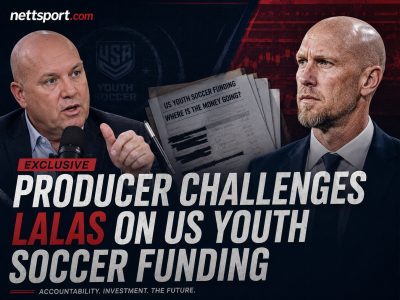
The recent World Cup exit for the USMNT has once again ignited a fervent discussion surrounding the foundational issues of American soccer, particularly the prohibitive costs associated with youth participation. At the heart of this ongoing debate is Alexi Lalas, a prominent voice in American soccer, whose staunch defense of a free-market approach to youth development has drawn significant attention and criticism. Lalas has consistently argued that allowing club soccer to price out some children will ultimately forge a “proudly unique” soccer culture in the country.
This perspective, frequently aired in debates with his followers on social media platform X, often culminates in Lalas posing the rhetorical question: “Who’s going to pay for all this free soccer?” However, this argument has been directly challenged by Seton O’Connor, a long-time producer for the Dan Patrick Show, who believes Lalas is overlooking clear, existing models for sustainable youth talent development. O’Connor’s rebuttal offers a compelling counter-narrative, suggesting that the answer to Lalas’s question is not only available but has been successfully implemented elsewhere.
The Persistent Debate Over Youth Soccer Costs
Following the USMNT’s tough exit from the World Cup, the conversation naturally pivoted back to the grassroots level of the sport. Many stakeholders and fans believe that the high financial barrier to entry for youth soccer in the United States is a significant impediment to developing a broader and deeper talent pool for the national team. Lalas, however, has remained steadfast in his conviction that market forces should dictate access, a stance that implies a lack of interest in actively reducing these costs to improve the talent pipeline. His arguments often frame any alternative as an unrealistic demand for something that inherently has a price.
Seton O’Connor, in a video response, articulated his frustration with Lalas’s viewpoint, stating pointedly, “The answer is right in front of Alexi Lalas’ face and he somehow never sees it.” O’Connor’s intervention has been widely discussed, as he presented a tangible example from Spain that directly addresses the funding question. This example serves as a practical illustration of how high-level youth soccer can be made accessible without relying on individual family finances, thereby challenging the core premise of Alexi Lalas’ ‘free soccer’ claim.
Seton O’Connor Refutes Alexi Lalas’ ‘Free Soccer’ Claim
O’Connor’s model for accessible youth soccer is CF Damm, a football club based in Barcelona, Spain. What makes CF Damm particularly relevant to the American debate is its unique funding structure. The club is entirely run and financed by the Damm brewing company, a corporation that O’Connor likened in size and scope to the parent company behind Samuel Adams beers in the United States. This brewing giant has made a strategic commitment to the development of Spanish soccer talent, operating CF Damm solely for this purpose.
Players recruited to CF Damm compete in the top division of Spanish youth soccer, a highly competitive environment where future stars are forged. Notable talents, such as Spanish national team phenom Lamine Yamal, have played in this very system, highlighting the caliber of development fostered by such a model. The existence of CF Damm directly contradicts the notion that “free soccer” is an impossible dream, demonstrating that corporate investment can indeed create robust, high-quality youth academies that are free for participants. This approach shifts the financial burden from individual families to a corporate entity committed to community and sport.
A Blueprint for American Talent Development
O’Connor’s argument extends beyond merely presenting an alternative; he challenges American corporations to consider their role in youth sports development. He suggests that instead of recycling the familiar “no such thing as a free lunch” arguments, the conversation should pivot towards asking why major American companies — like tech giants Apple or Google — do not prioritize and invest in youth sports development in a manner similar to the Damm brewing company. The implication is clear: a different corporate philosophy could unlock significant potential for American soccer.
This perspective underscores a fundamental difference in how societal contributions and talent pipelines are viewed across different cultures and corporate landscapes. The Spanish model, as highlighted by O’Connor, illustrates that significant investment in youth sports can be a viable and beneficial endeavor for corporations, yielding both community goodwill and a stronger national talent pool. The debate initiated by Alexi Lalas’ ‘free soccer’ claim and O’Connor’s powerful rebuttal is not just about funding; it’s about the vision for the future of American soccer and the pathways available to its aspiring young athletes. The question remains whether American industry will heed the call to invest in the next generation of soccer stars.