







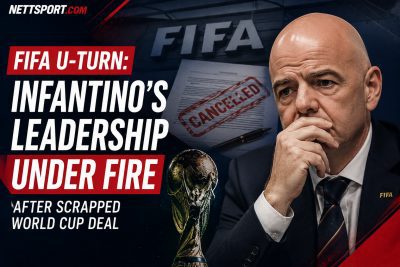
The football world is reeling from a dramatic reversal by FIFA President Gianni Infantino, who has scrapped his controversial proposal to sell off stakes in the World Cup and other major competitions. This sudden U-turn comes after a torrent of widespread backlash, culminating in a threatened boycott by European nations and a scathing rebuke from UEFA, the governing body for European football. The fallout has intensified scrutiny on Gianni Infantino’s leadership, with many now questioning his future at the helm of global football.
Infantino’s initial plan involved creating a colossal $20 billion company to manage the World Cup, inviting private investors to acquire stakes. However, the secrecy surrounding the proposal and its rapid timeline ignited fierce opposition from various football governing bodies worldwide. The pressure mounted daily following the announcement, forcing Infantino to concede. In a statement, he acknowledged that the project had “created divisions of a nature that, regardless of the level of support, are no longer in the interest of the objective set out in the first place.” This admission marks a significant moment, highlighting the deep fissures within FIFA’s own ranks and the broader football community.
A Swift U-Turn Amidst Widespread Opposition
The decision to abandon the lucrative sell-off plan was not made lightly, nor was it a voluntary act of introspection. It was a direct consequence of intense pressure and a unified front of opposition, particularly from UEFA. European football’s governing body had previously voted to boycott future World Cups if the plans proceeded, a powerful statement of dissent that underscored the gravity of the situation. This threatened boycott, championed by UEFA President Aleksander Ceferin, saw all 55 member associations pledge their support, demonstrating a rare display of solidarity against FIFA’s proposals. The withdrawal of the plan was subsequently hailed by UEFA as “a victory for the whole game,” signaling a moment of triumph for those who had vehemently opposed the opaque dealings.
Sources indicate that the backlash wasn’t confined to external bodies; criticism also emerged from within FIFA itself, with two senior officials reportedly criticizing the plan, and one even resigning as a presidential advisor. The sheer scale of the opposition made the continuation of the proposal untenable, forcing Infantino’s hand. The swiftness of the U-turn, coming just days after the initial announcement, speaks volumes about the power dynamics at play and the collective will of the footballing world to resist what was perceived as a detrimental commercialization of its most prized asset. For more details on the initial backlash, readers can refer to this report from ESPN.
Uefa’s Stinging Rebuke of Gianni Infantino’s Leadership
While the scrapping of the plan was welcomed, it did little to mend the fractured relationship between FIFA and UEFA. In fact, UEFA’s subsequent statements were remarkably strong, indicating a profound loss of trust in Gianni Infantino’s leadership. The European body issued a strongly worded statement demanding a “thorough and fundamental review of Fifa’s governance.” Their criticism was sharp, referring to “secret schemes,” “shabby backroom deals,” and “faceless individuals” as hallmarks of the current FIFA administration. This language leaves little doubt about the depth of their dissatisfaction and their belief that fundamental change is required at the top.
UEFA explicitly accused Infantino of failing to deliver on promises of transparency made during his 2016 presidential campaign. At that time, he famously declared, “The money of Fifa is your money. It’s not the money of the Fifa president. You are the national associations and the money of Fifa has to serve for the development of football and not for anything else.” UEFA’s statement highlighted the stark contrast between these pledges and the recent opaque investment proposal, asserting that Infantino had failed on both counts. The current FIFA leadership has not only lost UEFA’s confidence but also that of many other members of the football family, according to the statement. This sentiment is shared by many of the biggest football governing bodies across the world, suggesting a broader crisis of confidence in Gianni Infantino’s leadership.
The Road Ahead: Re-election and Governance Reform
The fallout from this controversy places Gianni Infantino under immense pressure as he prepares to seek re-election for a fourth term as president at the FIFA Congress in March. The prospect of a challenge to his presidency, once seemingly remote, now appears increasingly likely. Leading European officials are understood to have already begun the process of identifying a credible candidate to stand against Infantino in next year’s election. This search for an alternative leader will continue over the coming days and weeks, signaling a concerted effort to bring about a change in FIFA’s direction.
UEFA, under the steadfast leadership of Aleksander Ceferin, has made it clear that it will continue to push for significant reforms. The organization’s statement emphasized, “We cannot keep going on like this with secret schemes on fast track timescales, cooked up by faceless individuals and of dubious benefit to the game. We must identify those responsible and hold them to account.” This resolute stance indicates that the battle for transparency and improved governance within FIFA is far from over. The events of the past week have not only exposed deep-seated issues but have also galvanized a powerful coalition determined to reshape the future of global football. The full extent of the implications for Gianni Infantino’s leadership and the future of FIFA governance is still unfolding, as reported by The Guardian.