









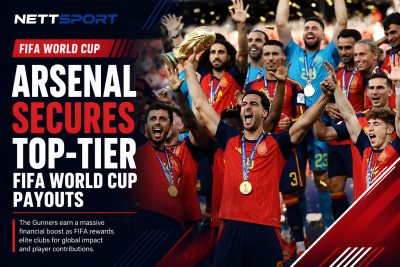
In a significant financial boost for one of Europe’s footballing giants, Arsenal is poised to be among the top earners from FIFA’s Club Benefits Programme following the 2026 World Cup. Analysis reveals that only three clubs worldwide will receive more substantial payouts than the North London side, underscoring their global player representation and the financial implications of international tournaments.
The Gunners are set to pocket a considerable sum, placing them fourth in the overall standings for clubs benefiting from FIFA’s initiative. This program is designed to compensate clubs for releasing their players to participate in the prestigious quadrennial tournament, acknowledging the vital role clubs play in player development and availability for national teams. The financial landscape of football continues to evolve, and these payouts represent an increasingly important revenue stream for elite clubs.
FIFA’s Enhanced Club Benefits Programme
FIFA’s commitment to supporting clubs that contribute players to the World Cup has seen a dramatic increase for the 2026 edition. A staggering $355 million (£265 million) will be disbursed to clubs, marking a substantial 70% increase compared to previous tournaments. This enhanced funding reflects the growing commercial success of the World Cup and FIFA’s desire to strengthen relationships with clubs globally. The distribution of this money is carefully structured to reward various levels of participation.
Of the total sum, $250 million is earmarked specifically for clubs whose players participate in the actual 2026 World Cup tournament. An additional $100 million has been allocated to reward clubs that released players for the qualifying rounds, recognizing the year-round commitment required. The remaining $5 million will be allocated for the broader benefit of club football, demonstrating a holistic approach to supporting the sport’s foundations. The payment mechanism is straightforward: clubs are entitled to approximately $5,000 per day for each player released for national team duty during the World Cup period. This daily rate accumulates rapidly, especially for clubs with numerous international stars who progress deep into the competition.
Arsenal’s Lucrative World Cup Payouts Position
According to detailed calculations by The Athletic, Arsenal is projected to receive an impressive $3.3 million (£2.46 million) from the 2026 World Cup Club Benefits Programme. This places them firmly in the top tier of global football finance, a testament to their squad depth and the international appeal of their players. The analysis highlights Arsenal’s strong position relative to other European powerhouses, with only a select few clubs surpassing their expected earnings.
Leading the pack in these lucrative payouts is Manchester City, anticipated to earn $4.4 million. They are followed by Spanish giants Barcelona, who are projected to receive $3.9 million. German champions Bayern Munich complete the top three, with an expected payout of $3.4 million. Arsenal’s $3.3 million figure positions them just behind these perennial contenders, showcasing their significant contribution of talent to the international stage. This financial injection, while not transformative for an entire summer transfer window, is certainly not insignificant and can be strategically invested. For more details on these figures, you can refer to the original report on Yahoo Sports.
Champions League Final’s Impact on World Cup Earnings
An interesting nuance in Arsenal’s payout calculation stems from their participation in the Champions League final. The Athletic’s report points out that Arsenal would have earned approximately $500,000 more from FIFA if they had not reached the final of Europe’s premier club competition. This is because their involvement in the Champions League final meant that their players were released to their respective national teams five days later than would otherwise have been the case. Fewer days with the national team during the designated World Cup period naturally translates to a slightly reduced payout from FIFA’s daily compensation scheme.
However, it is crucial to view this in context. The report emphatically highlights that Arsenal earned far more than $500,000 by making it to the Champions League final. The financial rewards, prestige, and commercial opportunities associated with reaching such a high-profile final far outweighed the minor reduction in World Cup payout. Therefore, despite the slight dip in FIFA earnings due to the late release, their Champions League success was a significant net financial positive for the club. The 2026 World Cup itself was a tournament of many narratives, as explored in this ESPN article, and its financial impact on clubs is just one facet.
The £2.5 million figure, while not enough to single-handedly fund a blockbuster summer transfer, represents a valuable contribution to the club’s coffers. This money could be strategically invested in various areas, such as bolstering the academy, funding targeted player acquisitions, or improving club infrastructure. For Arsenal, securing such a substantial sum from FIFA’s Club Benefits Programme reinforces their standing as a major player in global football, both on and off the pitch.