









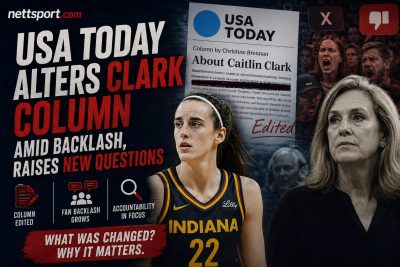
The sports media landscape recently faced a significant controversy when a USA Today column concerning WNBA star Caitlin Clark drew widespread criticism. Nancy Armour authored the piece, which quickly became a focal point of online discussion for its content and implications. The original column, focusing on Clark’s on-court actions—specifically her embellishing contact for fouls and attempts to influence WNBA officials—took an unexpected and highly contentious turn. This controversial Caitlin Clark column ignited a firestorm, prompting responses from both the author and the publication.
The Initial Firestorm Around the Controversial Caitlin Clark Column
The core of the backlash stemmed from Armour’s decision to link Clark’s on-court behavior to deeply sensitive and historically charged issues. Specifically, the column suggested Clark’s actions could potentially contribute to racist violence by white nationalist elements within her fanbase. An astonishing paragraph within the piece even drew a parallel between Clark’s alleged flopping and the lynching of Emmett Till, a comparison that immediately drew outrage across social media and beyond. Critics widely condemned this particular aspect of the controversial Caitlin Clark column for its perceived insensitivity and lack of proportionality.
Following the intense public reaction, Nancy Armour locked her X (formerly Twitter) account and subsequently issued a statement. In her statement, Armour described her words as “inartful” but notably did not offer an apology for the content itself. Instead, she expressed regret that her phrasing had detracted from what she considered the broader conversation about threats directed towards Black WNBA players. Initially, USA Today appeared to stand by its columnist. A spokesperson for the publication, commenting to Front Office Sports, asserted that Armour’s piece was an opinion column and stated that the outlet would not comment on the backlash. This stance further fueled the debate surrounding the controversial Caitlin Clark column.
Subtle Revisions and Lingering Questions
Despite their initial public defense, USA Today later made a subtle but significant change to Armour’s column. The publication appended an editor’s note to the piece, stating, “This column has been updated to provide further context and clarity.” This update, however, immediately raised questions about the nature of the revisions and why the publication chose to act after initially standing firm. The original paragraph that sparked the most intense controversy read: “It shouldn’t need reminding this country has an awful history of Black people being harmed, even killed, in the name of “defending” white women. The WNBA’s All-Star Game this weekend is in Chicago, Emmett Till’s hometown, and a local art gallery is currently hosting an exhibit imagining his life if he hadn’t been lynched. While it’s incumbent on the WNBA to do more to protect its players, there also should be an expectation on Clark to recognize the wider consequences of her actions.” After the widespread controversy and Armour’s own statement, USA Today edited this paragraph. Crucially, the publication did not entirely remove the reference to Emmett Till, a primary source of the outrage, but rather changed the ending. For a detailed look at the changes and the ongoing discussion, readers can refer to the Awful Announcing report on the matter.
The decision to edit the controversial Caitlin Clark column, while adding an editor’s note, drew mixed reactions. Some saw the update as an acknowledgement of the column’s problematic nature, even if an explicit apology remained absent. For others, the subtle nature of the change and the retention of the Till reference in any form suggested an incomplete attempt to correct the record. The incident prompted a broader discussion within sports journalism about the responsibilities of opinion writers and the editorial oversight major publications provide. The initial defense followed by a quiet revision has left many wondering about the internal processes and standards at USA Today.
The Broader Implications for Sports Journalism and the Controversial Caitlin Clark Column
The controversy surrounding the controversial Caitlin Clark column extends beyond the specific details of the piece itself. It highlights the delicate balance journalists must strike when discussing sensitive social issues within the context of sports. The incident underscores the power of language and the potential for unintended consequences, even when attempting to address important societal concerns. The public’s swift and strong reaction demonstrates the high level of scrutiny they place on media outlets, particularly when prominent figures like Caitlin Clark are involved. Analysts will likely examine the way USA Today handled this situation, from the initial publication to the subsequent edits and statements, for some time within media circles. The questions about editorial judgment and accountability that arose are significant. Readers can find further analysis of this evolving story at this link detailing the USA Today column changes.
In conclusion, USA Today’s decision to update its controversial Caitlin Clark column, while a step towards addressing the intense backlash, has not fully resolved the questions it initially provoked. The subtle nature of the revisions, coupled with the absence of a direct apology for the controversial elements, continues to fuel debate. This episode serves as a potent reminder of the complexities inherent in modern sports journalism, particularly when navigating the intersection of sports, race, and social commentary. The conversation around this controversial Caitlin Clark column is far from over, leaving many to ponder the lessons learned and the path forward for responsible sports media.