







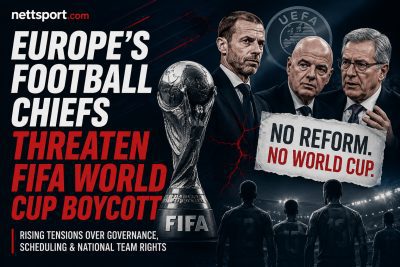
European football stands at the precipice of an unprecedented confrontation with the sport’s global governing body, FIFA. In a seismic development that reverberated across the football world, UEFA, representing all 55 of its member associations, unanimously agreed to boycott all FIFA competitions. This extraordinary measure will activate if FIFA President Gianni Infantino pushes forward with his controversial proposals to sell significant stakes in the World Cup and other flagship tournaments to private investors. UEFA made the decision at an emergency meeting on Thursday, July 30, 2026, drawing a definitive line in the sand and threatening to fundamentally alter the landscape of international football.
UEFA’s Unanimous Rejection of FIFA’s World Cup Sell-Off
The emergency meeting, which lasted just under two hours, saw UEFA members present a united front, quashing earlier speculation that smaller nations might be swayed by the financial allure of Infantino’s scheme. A statement from UEFA confirmed their resolute position, declaring that they “unanimously and unequivocally reject” the proposals. This collective refusal means that “no Uefa national teams will participate in any Fifa competition for so long as these proposals remain alive, unless this proposal has been abandoned in its entirety and binding assurances have been given that Fifa will never again open its governance or competitions to private ownership.” At the heart of the dispute lies Infantino’s intention to sell a 20% stake in a subsidiary company FIFA created to manage its competitions, including the prestigious World Cup. This entity, while FIFA intends to run it, private investors would partially fund, notably Joshua Kushner, the brother of former US President Donald Trump’s son-in-law. The profound implications of this World Cup sell-off could reshape the governance and financial future of global football.
Immediate Fallout and Looming Deadlines for the UEFA World Cup Boycott Threat
The ramifications of UEFA’s decision are both immediate and extensive. The proposed boycott will begin with the Under-20 Women’s World Cup, which kicks off on September 5 in Poland. This tournament features numerous European nations, raising serious questions about its viability should UEFA’s threat materialize. A senior European football source, when asked about the U20 Women’s World Cup’s fate, admitted, “Not sure the detail was considered when deciding the overall policy.” This uncertainty underscores the unprecedented nature of the situation. FIFA had set a deadline of September 19 for countries to formally accept its funding deal, which includes a potential $20 million (£15 million) payment by January 1 for participating nations. If Infantino proceeds, European teams could theoretically face compulsion to withdraw from the U20 Women’s World Cup mid-tournament, potentially before the quarter-finals. Furthermore, the Women’s World Cup play-offs in October, involving prominent European teams such as England, Scotland, Wales, and Northern Ireland, would also experience disruption. UEFA vice-president and former Wales international Laura McAllister articulated the deep concern, stating, “Nobody can even countenance the thought of not being involved in those.” She firmly asserted that FIFA created this crisis, not UEFA. The pressure on Infantino to significantly revise or completely abandon his scheme has escalated dramatically.
The Power Struggle: Infantino’s Weakened Position Amidst Boycott Threat
Gianni Infantino now confronts a formidable challenge. Despite the fact that most European FAs had previously submitted letters supporting his re-election next March, UEFA’s decisive and unified stance significantly challenges his authority. The prospect of a widespread UEFA boycott FIFA competitions poses a formidable obstacle to his vision for the sport. The European governing body’s unwavering declaration highlights a fundamental disagreement regarding the commercialization and stewardship of football’s most treasured assets. While no one desires players or nations to suffer, especially concerning the most prestigious competitions, UEFA feels it has been “pushed into this corner.” The onus is now squarely on FIFA. Infantino must weigh the risk of alienating a substantial segment of global football, including its most financially potent confederation, against abandoning his contentious World Cup sell-off plans. The coming weeks will prove pivotal in shaping the future landscape of international football and the leadership of its global governing body. The unity UEFA demonstrated suggests a protracted and arduous negotiation, or potentially, a profound realignment of the sport’s power dynamics.
Conclusion:
The football world holds its breath as the escalating standoff between UEFA and FIFA unfolds. European nations’ unanimous decision to boycott FIFA competitions over the proposed World Cup sell-off represents an unparalleled challenge to Gianni Infantino’s leadership. With crucial deadlines approaching and major tournaments hanging in the balance, the upcoming days will determine whether they can forge a compromise or if the sport faces a deep and potentially damaging schism. The crisis now critically puts the integrity and future direction of international football at stake.