






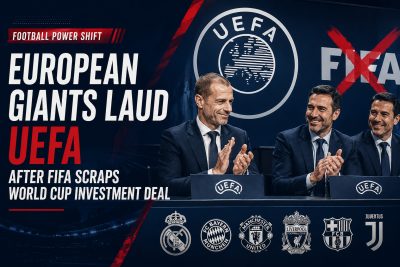
The football world is breathing a collective sigh of relief after FIFA officially abandoned its contentious plans to sell significant stakes in a World Cup company to private investors. The football community widely approved this pivotal decision, announced on Sunday, August 2, 2026, with European giants Real Madrid notably lauding UEFA for its unwavering commitment to safeguarding the sport’s integrity. The controversial proposal, which aimed to partially divest the commercial rights of FIFA’s flagship competition, faced a formidable wall of opposition from key confederations. This ultimately led to its withdrawal and marked a significant setback for FIFA President Gianni Infantino.
Real Madrid, a club synonymous with European footballing excellence and 15-time champions of the continent, wasted no time in expressing profound gratitude. Their official statement highlighted the critical role UEFA played, alongside other confederations and federations, in ensuring football’s future remained protected from what many viewed as an unwelcome commercial encroachment. This outcome is celebrated as a victory for the sport’s traditional values and its millions of passionate fans worldwide.
The Standoff: UEFA’s Firm Opposition
Intense pressure and a unified front from several powerful footballing bodies paved the path to this abandonment. UEFA, the governing body for European football, emerged as a leading voice against the proposed sell-off. Their opposition was not merely rhetorical; UEFA had publicly pledged to boycott FIFA competitions if the controversial idea proceeded, signaling a serious intent to defend what it perceived as the core principles of the sport. This strong stance sent a clear message to FIFA’s leadership regarding the depth of their concern.
Pressure on FIFA President Gianni Infantino escalated dramatically when UEFA declared he had “lost the confidence” of European football’s governing body. UEFA was even considering further action, including the possibility of triggering a no-confidence vote in the Swiss official. Such a move would require 43 FIFA member nations to back it, indicating the potential for a significant shake-up in global football governance. The unity UEFA showed was instrumental in forcing FIFA’s hand, demonstrating the power of collective action when the sport’s future appears at stake. The full story of the opposition can be read here.
Real Madrid Hails UEFA’s Stance
Following FIFA’s decision to abandon the plans, Real Madrid issued a statement that resonated deeply within the football community. The club articulated its position with clarity and conviction: “Real Madrid values very positively the decision taken by Fifa to abandon the proposal to partially sell the commercial rights of its competitions.” The club echoed this sentiment across its ranks, emphasizing that the outcome was not just beneficial for institutions but, crucially, for the global fanbase.
“Our club considers that it is good news for football, for its institutions and, above all, for the millions of fans of our beloved sport,” the statement continued. This powerful endorsement from one of the world’s most influential clubs underscored the widespread relief and approval. Real Madrid explicitly extended gratitude to UEFA, as well as to Concacaf, which governs football in North, Central America, and the Caribbean, and the Asian Football Confederation (AFC). These confederations had also spoken out firmly against the plans, forming a crucial alliance that ultimately proved decisive. Their “unity and sense of duty have protected football at a decisive moment,” according to the Spanish giants. This acknowledgment highlights the collaborative spirit that prevailed in challenging the proposed commercialization.
A Victory for Football Integrity and UEFA Protects Football
FIFA’s abandonment of its World Cup sell-off plans represents more than just a procedural reversal; many widely see it as a significant victory for football’s integrity and traditional governance. The unity UEFA, Concacaf, and the AFC displayed sent an unequivocal message. Private investment interests would not dictate the commercial future of the sport’s most prestigious tournament without broad consensus. This outcome reinforces the notion that football’s governing bodies, when united, possess the power to resist proposals that appear to undermine the sport’s foundational values.
This episode serves as a powerful precedent, demonstrating the critical importance of robust governance and the collective responsibility of confederations to act in the best interests of the game. UEFA’s pressure, culminating in the declaration of no confidence in Infantino, was a bold move that ultimately paid dividends. It underscored that the confidence of member associations is paramount for any leader in global football. This sustained and coordinated opposition directly resulted in the decision to abandon the plans, ensuring FIFA will not partially sell off the commercial rights of its competitions to private investors. Further details on the confederations’ unified stance can be found here.
The football community, led by the appreciative words of Real Madrid, can now look forward with renewed confidence. They know that the collective will of its governing bodies can indeed protect the sport at its most decisive moments. The outcome testifies to the power of unity and clearly affirms that the spirit of the game remains paramount.