








The USMNT’s 2026 FIFA World Cup journey concluded abruptly with a 4-1 defeat to Belgium in the Round of 16. This outcome quickly extinguished the initial good vibes surrounding the team’s first four matches. In the wake of this early exit, intense scrutiny fell upon star player Christian Pulisic. He was a non-factor in the elimination game, eventually leaving due to an injury. The days since have seen sports media members widely criticize the U.S. squad, with Pulisic often bearing the brunt.
Among the loudest voices has been Fox Sports soccer analyst Landon Donovan. He publicly blasted Pulisic for his substitution during the Belgium match, declaring, “You would have had to f*cking drag me off the field.” Donovan didn’t stop there; he later reiterated his doubts about Pulisic, claiming that players, staff, and sponsors around the USMNT expressed being “fed up” with his camp. This strong, public condemnation from a former national team legend has sparked considerable debate.
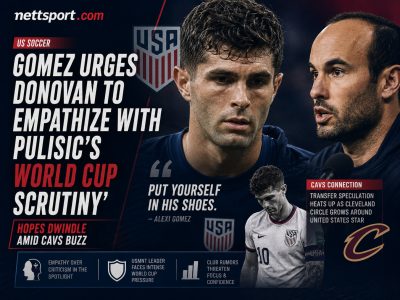
ESPN soccer analyst Herculez Gomez, however, expressed surprise at Donovan’s apparent lack of sympathy for Pulisic. During Thursday’s episode of First Take, Gomez highlighted the striking similarities in their playing careers. He suggested that Donovan, given his own past experiences, should understand Pulisic’s current struggles more deeply.
The Scapegoat Narrative: Pulisic Donovan Empathy
Gomez firmly believes that Christian Pulisic is being unfairly targeted in the aftermath of the World Cup. “I think what Christian Pulisic is going through right now, he’s being used as the scapegoat for this failed World Cup,” Gomez asserted. This statement underscores a common pattern in sports, where a prominent player often absorbs collective disappointment. The immense weight of expectation on Pulisic, often called “Captain America,” has been a constant. The team’s early exit has inevitably led to intense scrutiny directed squarely at him.
The ESPN analyst drew a direct comparison between the two players. “I find it interesting because Landon and Christian are the same person. They’re the same player. They should really understand each other,” Gomez explained. This observation forms the core of Gomez’s argument for greater understanding. He reminded viewers that Donovan himself faced a similar situation in 2006. At that time, Donovan was “used as one of the scapegoats for that disastrous World Cup campaign.” This shared history, Gomez contends, should foster solidarity, not antagonism.
Gomez acknowledged a complex “backstory” and “a lot of water under that bridge” between Christian Pulisic, his camp, and figures like Landon Donovan and Tim Howard. Public interactions involving Pulisic’s father have contributed to these underlying tensions over time. Despite these historical frictions, Gomez advocates for a different approach. He believes that instead of attacking each other or their respective camps, they should seek “some sort of coming to terms here, coming together and helping.” This call for unity and mutual support emphasizes the crucial role former national team stars can play in guiding the next generation, especially during challenging periods.
A Shared Path of Pressure and Scrutiny
Both Landon Donovan and Christian Pulisic have navigated careers marked by immense pressure. They carried the hopes of US Soccer. Each player emerged as a generational talent, tasked with significantly elevating the sport’s profile in the United States. Donovan, for many years, was the undisputed face of the USMNT. He experienced both the triumphs of iconic World Cup moments and the frustrations of collective failures. Pulisic inherited this mantle, becoming the most expensive American player in history and a pivotal figure for both club and country.
The intense spotlight on these individuals means that when the team underperforms, blame often falls heavily on their shoulders. Donovan’s experience in 2006, following a World Cup where the USMNT finished last in their group, closely mirrors Pulisic’s current predicament. The public and media’s reaction to perceived underperformance can be brutal. The emotional toll on players in such situations is significant. Gomez’s plea for empathy stems from his deep understanding of the unique pressures high-profile athletes face.
Beyond the Criticism: A Call for Understanding
Herculez Gomez’s intervention serves as a powerful reminder. While criticism is an inherent part of professional sports, it should ideally be tempered with perspective and understanding. The narrative surrounding Pulisic’s performance and injury in the 2026 World Cup has been largely dominated by negativity. This echoes the post-2006 narrative that Donovan faced. As reported by Awful Announcing, Gomez’s comments suggest that Donovan, having walked a similar path, is uniquely positioned to offer support rather than further condemnation.
Gomez’s call for “coming together” extends beyond mere personal reconciliation between two prominent figures in American soccer. It speaks to a broader necessity within the USMNT ecosystem. A culture of mentorship and shared experience is vital, especially when players navigate the intense scrutiny that follows major tournament disappointments. For more details on Gomez’s perspective, readers can refer to the original report on Awful Announcing. The hope remains that such discussions can foster a more constructive environment for the national team’s future. Lessons from the past should build, not tear down. The shared history of being a USMNT scapegoat should ideally forge a bond, not deepen a rift.