








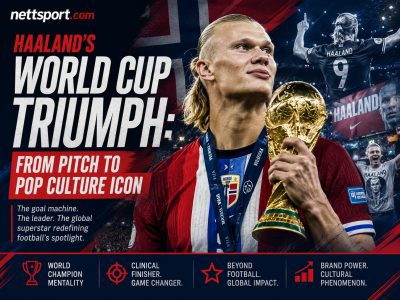
The World Cup 2026 was a stage for countless narratives, yet few captivated the global imagination quite like the story of Erling Haaland. The Norwegian goalscoring machine, already a formidable presence in European club football, transcended the sport itself during the tournament. Even as his national side, Norway, made their exit in the quarterfinals, Haaland’s individual journey became a cultural phenomenon. His unique blend of on-field prowess and off-field charisma, marked by everything from unexpected celebrity endorsements to viral social media moments, solidified his status. This remarkable run proved unequivocally that one could truly conquer the World Cup even in defeat.
The Goal Machine’s Global Ascent
Long before the World Cup kicked off, Erling Haaland was already a titan in the world of European club football. At just 25 years old, he had already secured prestigious titles, including both the Premier League and the UEFA Champions League, establishing himself as one of the sport’s most formidable and prolific strikers. His reputation for relentless goalscoring and powerful play preceded him, but the World Cup offered a different, more expansive kind of spotlight. During Norway’s compelling run to the quarterfinals, Haaland netted an impressive seven goals, a tally that firmly cemented his status as the tournament’s undeniable breakout star on the pitch. His on-field brilliance was undeniable, a testament to years of dedicated training, an innate understanding of the game, and sheer natural talent. For those eager to follow his club exploits, fans could continue to catch Haaland all season long fighting for Champions League glory on Paramount+. However, it was his electrifying World Cup performance that truly catapulted him into a new, unprecedented stratosphere of global fame and recognition. The world watched as he consistently delivered, game after game, showcasing a level of skill that few could match.
Beyond the Pitch: Erling Haaland’s Cultural Impact
What truly distinguished Haaland during the World Cup was his unexpected and widespread embrace by popular culture. His influence stretched far beyond the confines of the football stadium, permeating into the diverse worlds of music, fashion, and general social discourse. One of the most striking and memorable examples of this cultural crossover came from the legendary singer-songwriter Patti Smith. She shared a heartfelt Instagram appreciation post that prominently featured Haaland. The evocative picture, captured from behind, showcased the Norwegian in his vibrant red national jersey, his distinctive half-up, half-down blonde locks nearly as prominent as the name and number emblazoned on his back. This visual was accompanied by the experimental sound collage “Revolution 9” by The Beatles as a backing track, with Smith’s caption simply expressing “thank you for all the joy.” This unsolicited celebrity endorsement was a powerful indicator of the unique way Haaland had resonated with a broader, non-traditional football audience.
Fans widely shared and discussed his image and persona in connection with various other cultural touchstones throughout the tournament. This included the unexpected surge in popularity for “Take Me Home, Country Roads” during the U.S. men’s national team’s memorable run, and even the Boston Globe’s full-page advertisement dedicated to thanking Scotland’s passionate Tartan Army. Yet, despite these other moments, few individual phenomena took off quite like Haaland himself. His distinctive appearance, often featuring that now-iconic blonde hairstyle, combined with his powerful yet playful presence, made him instantly recognizable and endlessly meme-able. The world, it seemed, was genuinely having fun with Haaland, embracing his unique persona with open arms. He rapidly became a viral sensation, accumulating an astonishing 25 million new social media followers during his relatively brief World Cup campaign. This organic and explosive surge in popularity was achieved remarkably without the extensive, pre-planned marketing efforts often deployed on behalf of other high-profile athletes. His appeal was authentic, driven by performance and personality.
How Erling Haaland Conquered the World Cup, Even in Defeat
Despite Norway’s eventual elimination in the quarterfinals, Erling Haaland’s impact on the 2026 World Cup was undeniably indelible and far-reaching. He arrived at the tournament as a known quantity to football aficionados but departed as a bona fide global icon, a testament to his extraordinary ability to transcend the traditional boundaries of sports stardom. His impressive tally of seven goals was a significant individual achievement, showcasing his elite scoring ability. However, it was his unparalleled capacity to capture the public’s imagination, from inspiring Patti Smith’s artistic appreciation to sparking countless viral moments involving everything from cowboy hats to his signature celebrations, that truly defined his tournament experience. He was much more than just a prolific goalscorer; he was a cultural touchstone, a figure embraced enthusiastically by fans, celebrities, and casual observers alike. The tournament’s breakout star status was undoubtedly earned by Haaland, who became recognized as the World Cup’s most viral star. His remarkable journey demonstrated powerfully that victory isn’t always measured solely by the final trophy or the ultimate team triumph, but sometimes by the sheer force of an individual’s personality and their profound ability to connect with millions worldwide. Indeed, Erling Haaland conquered the World Cup in a manner few players ever have, leaving an enduring and unforgettable mark on the tournament’s rich legacy. His legend was forged not just in goals, but in moments that resonated globally.