









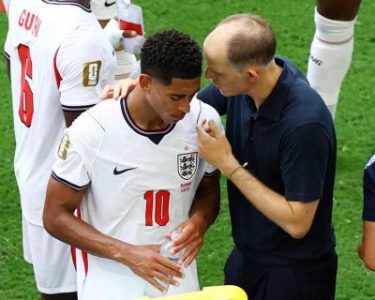
The dust had barely settled on England’s hard-fought 2-1 victory over Norway in the 2026 World Cup quarter-finals when a different kind of storm began brewing. In the stifling Miami humidity, a public exchange between manager Thomas Tuchel and star midfielder Jude Bellingham ignited a debate that threatened to overshadow the Three Lions’ progression to the semi-finals. What initially appeared to be a clear sign of a deep-seated rift, a palpable England manager’s perceived World Cup disconnect with star Jude Bellingham, might, upon closer inspection, be more nuanced than the headlines suggest. This unfolding drama has captivated fans and pundits alike, raising questions about team unity at a crucial juncture.
Setting the Stage: A Tense Quarter-Final Aftermath
England’s journey through the World Cup 2026 has been marked by moments of brilliance and resilience, culminating in a nail-biting 2-1 triumph against a formidable Norway side. The quarter-final clash, held at Miami Stadium on July 11, 2026, saw England secure their place in the final four, a significant achievement. However, the immediate post-match analysis from manager Thomas Tuchel struck a discordant note. Speaking to ITV’s Gabriel Clarke on the field, Tuchel did not mince words, describing his team’s performance as “sloppy,” “not fast enough,” and riddled with “technical mistakes.” He even went as far as to say England was “lucky” to escape with the win. Tuchel included praise for the team’s mentality in his assessment, but critical observations largely overshadowed it, creating an environment ripe for tension. This candid evaluation, delivered moments after a high-stakes victory, set the stage for the public disagreement that followed. The pressure of a World Cup quarter-final, combined with the challenging playing conditions, often leads to raw emotions, and Tuchel’s comments were a stark reflection of his high expectations, even in victory.
The Perceived World Cup Disconnect: Bellingham’s Blunt Response
Tuchel’s unvarnished critique prompted Jude Bellingham’s response in the mixed zone. The young midfielder, who had scored one of England’s goals in the match, did not shy away from expressing his own perspective. With a shrug and a raised eyebrow in one interview, Bellingham curtly stated, “Yeah, well, whatever… it’s difficult out there.” He elaborated further in another, delivering a response that immediately raised eyebrows across the football world. “Maybe he doesn’t know what it’s like to play in those kind of conditions against Erling Haaland, [Martin] Ødegaard, [Antonio] Nusa, [Alexander] Sørloth,” Bellingham asserted, referring to Norway’s potent attacking lineup. He continued, emphasizing the team’s efforts: “I think we tried to create a positive environment. We should continue that going into the final four. I can’t speak highly enough of the lads. … Sometimes you have to win dirty and we did that again tonight.”
Pundits widely interpreted this forthright retort as a direct dig at Tuchel’s own playing career, which was notably less illustrious than his managerial one. The obvious lack of synergy between the manager and his star player became a dominant talking point, fueling the narrative of a significant England manager’s perceived World Cup disconnect with star Jude Bellingham. While Bellingham’s passion and defense of his teammates were clear, the timing and nature of his comments risked diverting attention from England’s historic progression. The incident quickly became the focus, rather than the team’s achievement, highlighting the delicate balance required in managing a high-profile squad under immense pressure. The tension between the two figures was palpable, and many wondered if it would become a detrimental distraction. For more on the unfolding tension, one can read this analysis from The Guardian.
History and the Road Ahead for England
The recent exchange between Tuchel and Bellingham is not an an isolated incident but rather the latest chapter in a history of friction. There is a backdrop of past disagreements that likely underpinned Bellingham’s strong reaction. Tuchel had previously dropped Bellingham from England’s squad in October 2025, and earlier that year, in August, he had used the word “repulsive” to describe Bellingham’s on-field behavior. The manager later apologized for the “repulsive” comment, attributing it to English being his second language and an unintentional choice of words. Nevertheless, these past moments undoubtedly contribute to the current dynamic, making the England manager’s perceived World Cup disconnect with star Jude Bellingham feel more deeply rooted.
With England now facing an epic semi-final clash against Argentina in Atlanta, the timing of this public disagreement could not be worse. The team cannot afford distractions as they stand on the cusp of potentially reaching a men’s World Cup final for the first time on foreign soil. The focus must shift entirely to preparation and unity. Bellingham’s performance throughout the tournament has been stellar, including his brace against Norway, which the 2026 World Cup Golden Boot standings track. His individual brilliance is undeniable, but one player alone cannot win a World Cup. For England to succeed, a collective effort and a harmonious environment are paramount. The challenge for Tuchel and Bellingham now is to cool the tension, address any underlying issues, and ensure that personal differences do not derail the national team’s historic aspirations. The eyes of the nation are on them, hoping they can mend this perceived rift for the greater good of the Three Lions’ World Cup dream.
The narrative of a significant England manager’s perceived World Cup disconnect with star Jude Bellingham has undoubtedly added a layer of drama to England’s World Cup campaign. While the immediate post-match comments and historical context paint a picture of tension, the true depth of the rift remains open to interpretation. Whether it is a genuine breakdown in communication or simply the raw emotions of a high-stakes tournament playing out in public, one thing is clear: for England to achieve its ultimate goal, a resolution, or at least a temporary truce, is essential. The focus must return to the pitch, where the Three Lions have a chance to make history. The ability of the manager and his star player to navigate this challenge will be as crucial as any tactical decision or individual moment of brilliance in the matches to come.